• Skip to main content
  • Skip to primary sidebar
  • Skip to footer

Dragon Lake Books

The home of great stories

  • About
    • Sample Chapters
    • Events
    • Privacy policy
  • Where To Buy
  • My 100 Goals Blog
  • Contact Form
  • Mailing List Sign-up

Writing

It’s all about the story

June 28, 2017 by frozbie Leave a Comment

Fallen Warriors was a real learning experience for me. I intended the plot to go in one direction, but wasn’t totally sure how that would look. In the end, by allowing my characters to direct the story, I ended up pretty close to where I’d wanted to, but had followed them all through some unexpected journeys.

I now have a situation – as I set out to write the sequel – where none of my character journeys are complete, where each of them still has some internal demons to battle.

Unlike with Season One, I don’t yet have a definitive ending I’m heading for. Well, that might not be totally true…

I’ve been jotting down plot ideas for months and I need to revisit those. I think that at one point I did think I had an overall aim for both Season Two and Season Three, but it may have been quite vague.

I’m intending to start this writing journey by storyboarding the overall plot:

  • One main story arc to link all three books.
  • Two major story arcs for books two and three.
  • Minor story arcs for each character that may stretch over both books, or may end and then spark a new arc.

For this I’ll draw on resources like the Three Act Structure for Novelists (by Fiona Veitch Smith.)

I’m extremely nervous about tying it all together!

But, I know I can, because I’ve already done it once.

All of that sounds very analytical yet I believe people are enjoying Fallen Warriors because it is ultimately a story about real people, facing real struggles, and in the end, overcoming them… Or not!

I enjoy writing stories for much the same reasons people enjoy reading them. I get an emotional rush as I place my characters in situations that tear them apart, break them down and then give them hope. Over the summer it’s all going to be about the story!

Filed Under: 100 Words 100 Days, Fallen Warriors, Writing Tagged With: 100X100, character journey, pantser, plotting, three act story structure

How much can you write in a day?

June 27, 2017 by frozbie Leave a Comment

How much can you write in a day? This is a question that I keep returning to as I plan to write the sequel to Fallen Warriors. I wrote the first draft of The Great Scottish Land Grab in a month, writing an average of 2,300 words a day for 22 days in November 2011. It took me two and a half hours each day to write that.

But, then I ended up ditching half of that novel – easily 25,000 words – as I rewrote and edited the final version.

In theory I know I can write 5,000 words a day, but what is the point if I then need to discard half of that?

Well, on the plus side, you never know exactly what will work until you try. It is sometimes only during the writing that the story becomes clear, that the characters start to live. We change as writers as we become more experienced. The fact is that both for Land Grab and Fallen Warriors, during the rewrite, I added new scenes and extended existing scenes, essentially writing a new first draft that was actually good enough to become the final draft.

The hope is that having set up the background in Fallen Warriors Season One, having a pre-existing backstory and characters, that writing the sequel will be less work.

I will have child care responsibilities during the summer so am planning to get up at Six each morning, write for five hours plus a one hour break, and then leave the writing for the rest of the day.

My plan is to write 1,000 words an hour.

I expect I will take a couple of weeks off during the nine weeks that make up July and August, so I will only have seven weeks available to write.

Five thousand times five days times seven weeks = 175000 words…

Okay, I’m actually planning to write first drafts of both novels, Season Two and Season Three this summer.

Is it achievable?

I won’t know until I try, but in theory it should be.

The real benefit though is that it allows me to ensure that both plots are consistent, that there is an overall story arc connecting the three seasons and gives me more flexibility to end Season Two at an appropriate stage that will hopefully satisfy readers and leave them hooked for Season Three.

Anyway, that’s my plan for writing the sequel to Fallen Warriors and an estimate of how many words I’m planning to write each day. How much can you write in a day?

Filed Under: 100 Words 100 Days, Fallen Warriors, Writing Tagged With: 100X100, editing, planning, sequels, word count

God loves a good story

June 25, 2017 by Mark Anderson Smith Leave a Comment

Take the book of Esther. You have a beautiful young woman, sent to work for a rich and powerful man who seduces her and… (Wait a minute, just where did the idea for Fifty Shades come from?)

Anyway, we have a classic villain, Haman, who wants to kill every single Jew everywhere. (Genocidal villian – Ian Fleming could have based a few characters on him…)

We have the wizened old man, Mordecai, acting as mentor and spiritual guide… (A source for George Lucas’ Obi Wan Kenobi?)

The heroine risks her life to save her people, tricking her enemy and eventually leading a revolt that sees the Jews rise up to overpower those who would have slaughtered them.

Without doing too much reading between the lines, you have an orphan story, romance, sex, political intrigue, thriller and violence.

Someone should really make a movie out of that book!

Filed Under: 100 Words 100 Days, Jesus, Writing Tagged With: 100X100, Esther, Fifty Shades, George Lucas, Haman, Jews, Mordeci, Obi Wan Kenobi, Star Wars

10 ways to fail at publishing and marketing your book

June 24, 2017 by Mark Anderson Smith 4 Comments

When you’ve never done something before there is a high chance you’ll try things that just don’t work. Then again, perhaps you’ll eventually look back and have mixed feelings about what you did. I’ve found that I’m not at all sure that every mistake I made while publishing The Great Scottish Land Grab was quite as bad as I saw it at the time.

For the last few days I’ve been carrying out an analysis of Sales of The Great Scottish Land Grab. You can find my first post here and Thursday’s here. (Friday is my flash fiction day…)

Here is a round up of some of my biggest (maybe) fails while publishing and marketing my first novel:

1. Paying for a libel read
In 2014, in the UK, if you wrote a book defaming a person or organisation you could find yourself being sued. The situation in the US is much safer for writers and it may have improved in England with recent law changes, but don’t quote me on that! Currently in Scotland an MSP (Member of the Scottish Parliament) is being sued for defamation for something published on his blog.

Defamation of character is a problem I have mixed feelings about. On the one hand I don’t think we have an absolute right to say whatever we like about other people. On the other, I think that defamation law is abused in the UK to protect the rich and powerful. I think the law in the US is too lax while the law in the UK is too extreme. There has to be a better way.

Regardless, when I set out in early 2014 to rewrite Land Grab, I knew I needed to be careful. The first draft lampooned various well known political figures and while politicians are one group of people who can be legitimately targeted with humour, there was a real undercurrent of nastiness as the Scottish independence referendum grew closer. One of the main campaigning groups – Better Together – had set itself up as a limited company, potentially allowing it to sue anyone who attempted to defame them.

I run my own company and had no desire to lose that, or my house if someone took offence at what I was planning to publish.

I contacted several solicitors for quotes and ended up selecting one. They read each of the three books as I wrote them and offered their legal opinion on whether I was at risk of being sued. It cost me £2,580.

Just to put that into perspective, I receive £1.67 per ebook novel sold through Amazon. I will need to sell 1,545 full ebooks novels before I break even on that cost.

As I wrote here, I’m nowhere close to that.

I have regretted that decision. Yet, as I wrote above, I have mixed feelings about it.

I was extremely nervous about publishing my first novel. The process of discussing the situation with the solicitor and applying his advice gave me a confidence that helped me overcome a real hurdle. In my writing now, I’m conscious of the threat of defamation and do research my characters to ensure I’m not inadvertently libelling real people.

I believe that far too few indie-authors give proper thought to the risk of defamation. Certainly if you’re writing fantasy or off world science-fiction you are unlikely to be at risk, but even in these genres, if you lazily base a character on a real person and that person can identify themselves – and is offended by how you’ve portrayed them – and they can show it in court, you may find that that catch-all declaration “Any resemblance to actual people living or dead, events or locations, is entirely coincidental.” doesn’t save you from legal costs…

And that is the real killer in the UK. You can win your case, but still lose everything when the bill comes in.

2. Paying for indemnity insurance
Being aware of traditionally published authors who had found themselves in court defending themselves against defamation, I decided to take out indemnity insurance, insurance that covers legal costs and gives some protection against damages awarded.

Six months on and £265 lighter I cancelled the insurance. The fact was that I’d already paid more in insurance premiums than I’d earned on book sales. I’d sold nowhere near enough copies to think that I’d managed to find someone who would consider themselves defamed and since I’d followed the solicitor’s advice, it was extremely unlikely anyone would have a case against me.

Again, the act of taking out the insurance policy gave me confidence to write what I felt needed to be written, while also reminding me to take care with how I did it.

Still, that’s another bill that it’s going to take some time to pay back…

If you are writing a contemporary novel and there is a risk that you could defame someone, even inadvertently, it may be worth you considering.

3. Rush into marketing decisions
In the summer of 2014 I was commuting to Edinburgh from Cumbernauld on the train and I had this brain wave that I could get a T shirt printed up with the book cover on it and could become a walking advertisement for the book.

It was a disaster.

I still was in love with my first cover design and was filled with a sense that if I didn’t get the word out there about the book, no-one else was going to.

I turned up at a printer with a USB drive and the notion that since everyone was obsessed with voting Yes or No in the referendum, I should add some text above the book cover image saying:

Vote Yes?
Vote No?
Vote For…

It didn’t take long for me to decide that wearing that T shirt may actually do more harm than good.

Fortunately that mistake only cost me £12.95

4. Don’t tell anyone how to buy your book
I think I’ve mentioned this already, but it is worth repeating. I had thousands of leaflets and business cards printed up, none of which told people how to buy my books on Amazon. I still mentally kick myself over that mistake.

It meant that every time I gave out a leaflet or card, I had to tell people where they could buy the book. Yes, some of those people did then log onto Amazon and did buy it, but I’m sure I could have given more leaflets out and had more sales with just a few extra words telling where the book was on sale.

5. Tell people your book will make them scream
Unless your genre is horror, that just doesn’t work, trust me…

I was desperate for someone to review the first book in my trilogy and allow me to include their quote on my marketing material. Unfortunately, one of my earlier reviewers was extremely taken aback by my reveal and cliff hanger ending at the end of book one and wrote the following:

“Interesting ideas as one man searches for answers to the direction his life has taken, to the backdrop of the referendum. Knowing the author I can see where the story could be going, but I’m sure he will surprise me. I would recommend this to anyone with an interest in current events in Scotland, though I know a fair few who would be shouting at the screen. Look forward to the next instalment if only to find out what he has done to Eck”

For some reason I thought referring to this reaction would be a good idea. I think that deep down, I want to avoid people having a negative reaction to what I’ve written and so want to warn them that it might be somewhat controversial…

I foolishly included the following statement on business cards I had printed up:

“Described by some as an easy read, by others as making you want to shout at your screen
The Great Scottish Land Grab
Scotland’s future is in your hands”

It’s wrong on so many levels.

I’m advertising a book, why is it talking about a screen? I could see people reading it, confusion growing on their face as they asked me what I was selling them.

Then there was the statement about shouting (okay, not screaming.) How many readers actually want to sit down, relax and get comfortable with a book that might make them throw it across the room?

6. Don’t try and get reviews for your book
While there are clear benefits from splitting a book into a series and making the first part free, one downside is that you will draw reviews away from your main book.

With Land Grab I wasn’t very focused on reviews. I was delighted to get them as I published each book in the series, but was focusing far more on selling copies than trying to get reviews.

Then, when I published the full novel, I failed to ask people I’d known to go on to review the full novel. As a result, three years on, I still only have one review for The Great Scottish Land Grab – The Complete Trilogy. I need to rectify that!

For the last few months, almost a year now, I’ve been almost totally focussed on Fallen Warriors, but Land Grab is still a book of interest and at some point over the summer I need to get my begging cap on and start asking people for reviews because even just a few positive reviews make a huge difference to how people perceive your book.

7. Waste time by contacting people who are never going to review your book
I emailed every single MSP (Member of the Scottish Parliament) and offered them a free copy of Land Grab. All 129 of them.

It was such a waste of time. A couple did write back, but the vast majority either ignored the email or it went straight into spam. You would think a novel exploring issues around independence might appeal to a few politicians, but how many of them actually have time to read. Especially during the run up to a critical referendum.

I’ve started to discover this group of people called book-bloggers… They are the people I really need to get to know and spend time on…

8. Rush out and get thousands of leaflets and business cards printed
While getting thousands of leaflets printed is a cost effective way to go about it, the problem is with the rushing.

However much time you spend on your book cover, you probably should spend as much or more on your marketing material. You get it wrong and you’ve just invested in some very expensive fire lighting material…

I still have several thousand leaflets and cards that I really should just recycle. I confess that the whole situation is holding me back from getting better thought out material printed up. That’s something I need to overcome soon.

9. Expect bookshops to buy your Print On Demand books
Print On Demand is not the way to go if you intend to sell paper copies. The per unit cost is way too high and that’s before you factor in delivery costs and the discount the bookshop will need to make it worth their while stocking your book! Finally, you may have to accept returns to be stocked by many bookstores. Not all of them, but most.

Using CreateSpace is great for getting your book available online and ordering a few copies to sell yourself to friends and family, but it is a poor option for small print runs compared to contacting a book printer and ordering 50 or 100 copies.

I actually walked into bookstores asking them if they would like to stock my book when all I had was a couple of POD copies. Once I realised I would make no profit on the deal, I gave up. It seemed like too much effort for no reward.

I’m now working towards my first small print run for Fallen Warriors and will go back to organise one for Land Grab over the summer.

10. Give up.
At various times over the last few years I have given up. I stopped writing, I stopped trying to market my novel, I stopped trying to get it into bookstores.

Giving up is the easiest way to slide into oblivion. If you never write another book, people will forget about your first one. If you never try and sell your books, people won’t know to buy them.

Don’t give up!

If you have a good story, if you believe in your heart you are a writer, keep trying. Keep trying different methods until you find one that works. If you can learn from my mistakes above and avoid them, great! You probably will make your own mistakes and that’s okay. If we want to achieve anything great in life, we’re going to make mistakes.

To misquote Edison: “You might find 10,000 ways to fail at publishing and marketing your book, but all you need to find is one right way…”

Are you willing to share some of your biggest mistakes below?

Filed Under: 100 Words 100 Days, The Great Scottish Land Grab, Writing Tagged With: amwriting, bad choices, ebooks, failure, KDP, mistakes, POD, publishing, The Great Scottish Land Grab

Friday Flash Fiction: Left Behind

June 23, 2017 by frozbie Leave a Comment

‘Switch to South… Okay, he’s up again. End Command.’ Walter quickly scanned the other 359 images he was responsible for to see if any had “lost” their target. The board was green and he turned back to the memo he’d been reading before he’d been distracted.

GCHQ was ramping up their monitoring of the population, with a 400% increase in random surveillance to be offset by server and software improvements, that meant they would only need an extra ten staff.

Old George would be spinning in his grave if he could see his “office”, Walter thought to himself. He leaned back and nudged his chair so it moved out from his cubicle and he gave a lazy scan left and right. Ten cubicles to his left, thirty nine to his right and four rows behind him, collectively monitoring up to 90,000 citizens at any one time. He scooted forwards again and closed the memo, pulling up the next email.

Walter had never been able to fathom the amount of storage or processing capacity required, but then he didn’t need to know that. His role was to direct the acquisition of signal when the computers couldn’t recognise the target and provide in depth analysis when required. Which was happening more frequently, he admitted to himself.

When he’d started at GCHQ, three long years ago, he hadn’t been surprised to find out the government had quietly stepped up their monitoring of suspected terrorists.

He had been surprised to find out what capabilities they now had.

George had only envisaged a camera in every home, we had given the government far broader access by willingly accepting a camera on every smartphone. Not just one camera either, and not just the two that most people thought their devices possessed. A secretive bill had been passed forcing all makers of mobile phones to install a full six in each device, one for every direction allowing the government to obtain a full 360 view of people’s lives and even continue spying when the main cameras were covered. Front, Back, North, South, East and West, wherever you went, the government would go with you, at least if you were a person of interest…

‘Walter.’

He started at the sound of his supervisor’s voice, turned to see Marsha standing observing his board. ‘Good afternoon,’ he said, his pulse quickening slightly.

‘You’re monitoring suspect 2897.’ A statement, not a question.

‘Let me check.’ William entered the identifier into the search form and saw one of the images on the board expand to fill half the available display, the others shrinking in size to make room. ‘A burner phone,’ he said, reading from his monitor. ‘Bought four months ago, activated last week. Facial recognition identifies suspect as Josef Karrakis of Algerian origin.’

‘Bring up all feeds from his phone.’

Walter selected the option and the large image split into six, three of which were obstructed, one which showed an empty wall. As well as the target though, one of the other images showed two people… He looked round at Marsha.

‘Excellent. We received intel that a meet was happening. Run facial recognition on those two and spin back the feeds to see if you can get audio or anything else of use.’

‘Will do.’ He noted that Marsha hurried away, her role demanding she divide her time between the urgent and top priority.

Before he did anything, he messaged a colleague to ask him to begin active observation of the still in progress meeting. It wouldn’t do to miss something important because he was reviewing the start of the meeting!

All feeds from a device were linked which allowed him to skip back, watching the images in step with each other. He identified the start of the meeting, logged the timestamp and set it to play at twice normal speed. The meeting had been going for just over an hour and he spent the next hour catching back up to real time.

Most of the discussion was un-actionable, but disturbing in its content. He wrote up commentary as he listened and then when the meeting broke up, summarised it and emailed everything to Marsha.

Stretching, he checked the time and decided it was time for a rest break. He logged off his system which automatically reassigned the feeds he was monitoring amongst his colleagues. He pulled his phone from his pocket and checked for messages, then left it on his desk while he went to use the toilet.

He stopped by the canteen on the way back, got a double shot coffee and was sipping it as he reached his cubicle.

Marsha was there, sitting in his chair, his phone in her hand.

‘Walter, you left this behind.’ She handed him his phone which he glanced at before putting it back in his pocket.

‘Thanks for sending me the summary of the meeting,’ she said, standing and allowing him room to sit down. ‘Place an audio alert on his device, log everything it records and keep an eye on the transcripts.’

‘Will do,’ he said.

She studied him for a moment, then turned abruptly and walked away.

He pulled his phone back out and unlocked it. The front camera caught his eye as he checked once more for messages. He locked his phone quickly and put it away in his pocket. Looked round at the tall dividers which cordoned off his row from the next bank of cubicles. Wondered, just for an instant, whether someone there had seen his face on their screen…

Copyright Mark Anderson Smith 2017 http://www.dragonlake.co.uk/ You may link to this post from http://www.dragonlake.co.uk/2017/06/friday-flash-fiction-left-behind/ or share on a non-commercial website so long as the full copyright notice and this statement is included.

Let me know what you think of the story below…

Filed Under: 100 Words 100 Days, Short Story, Writing Tagged With: 100X100, 1984, Big Brother, Flash Fiction, GCHQ, George Orwell, privacy, Surveillance

Analysis of Sales of The Great Scottish Land Grab Part Three

June 22, 2017 by frozbie Leave a Comment

Continuing a short series analysing sales of my first novel: The Great Scottish Land Grab. You can find yesterday’s post here and the first post here.

Every author’s story will be slightly different. I’ve benefitted from reading and hearing about the lessons other authors have gained from their experiences selling their books so it makes sense to offer what advice I can from my own experience.

What worked

1. Don’t discard rubbish first drafts
The first draft of Land Grab was not great, but it contained large sections that contained the core of the story I wanted to tell and on re-reading a couple of years later, still thrilled me.

I was extremely fortunate to have a relevant first draft waiting when I realised the level of interest in the Scottish independence referendum. If only I’d realised it sooner, but in reality, much of the plot of the finished book came out of my own journey exploring the issues. I doubt I could have written the novel, especially my first, at any other time. I was told from an early age to write and save what I wrote as it may become useful later. It’s good advice.

2. Be aware of what people are interested in
My decision to try and publish Land Grab in 2014 was definitely the right one. I made sales I might not have made at any other time. The original idea for Land Grab was for someone to try and steal a General Election to gain power and use it to reverse the Highland Clearances. As my interest in the referendum grew, I realised it offered a ready made situation that could be exploited in my plot and I began to rework the story to fit a topic all of Scotland was interested in.

Yet trends can easily vanish, as happened in October 2014. The No vote won and my sales began their quick slide towards zero.

Still, almost three years later and interest in Scottish independence has had a resurgence following Brexit… I’m still selling this book three years on…

3. There is no substitute for advertising
If you want to see zero sales, don’t market your book. If you want to sell one copy, tell someone you’ve written a book. Then tell someone else. Repeat until one of them buys it! If you want to sell hundreds or thousands of copies… You have to tell thousands or even millions of people.

How you advertise is possibly less important than the fact you are doing it. As long as you are reaching out to people who might be interested in your book, you may see some sales.

I’ve managed to sell dozens of copies by approaching strangers and talking to them about my novel. I found out this year that I could also sell copies by paying for Facebook advertising and I’m now also experimenting with Amazon Ads.

Time or money, you have to pay at least one of them and probably both and if you do it right, with a good product, you’ll find that you will sell.

4. A good cover will help, but a poor one won’t stop people if the concept is right
My first book cover was poor:

Yet, if you look at yesterday’s post, I still managed to sell a hundred copies. I knew it wasn’t the best I could do and kept trying different ideas, using this one when I released book two:

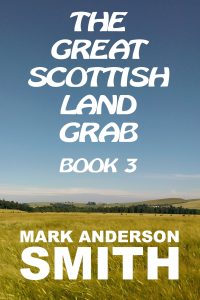
By the time book three was almost ready, I’d convinced myself I needed to show another side to Scotland and settled on this:

The last chapter written, the third book in the trilogy published, I listened to reason and hired a graphic artist: David MacKenzie who took a new concept I’d wanted and produced what became the final cover for The Great Scottish Land Grab:

David was kind enough to produce related covers for each separate book in the trilogy as well which you can view here.

5. Telling people how to buy the book
When I’ve told people they can buy copies on Kindle or physical copies through Amazon, they have. When I’ve told them there is a book, but failed to include that vitally important where to buy, I suspect they haven’t… It’s rather embarrassing to admit that on my leaflets and business cards I forgot to include that vitally important piece of information!

6. Split your book and make the first part free
Or write a short story or novella or prequel and give that away.

While giving the first part free is no guarantee that anyone will read it, let alone go on to buy the rest of the novel, I am seeing results where I’ve advertised the novel and let people know they can try the first book for free. If they are interested enough to act on your request and download the book, I think people will be more inclined to read it. Then, they may enjoy it and go on to buy the rest…

Want to start reading book one of The Great Scottish Land Grab for free? Click here…

7. Don’t give up!
If you have written a good story, then believe in yourself. Publishing is a long game and as many more experienced writers than myself have said, ebooks will be there long after printed copies are removed from the shelves.

My intention is to keep writing, keep selling and keep learning.

If you have any advice to share on your experiences of selling your books, why not comment below.

Filed Under: 100 Words 100 Days, The Great Scottish Land Grab, Writing Tagged With: 100X100, How to sell books, indie-author, publishing, self-publishing

  • « Go to Previous Page
  • Go to page 1
  • Interim pages omitted …
  • Go to page 5
  • Go to page 6
  • Go to page 7
  • Go to page 8
  • Go to page 9
  • Go to Next Page »

Primary Sidebar

Follow

Follow me on:

Recent Posts

  • Goal 31
  • Q2 Halfway point
  • The 12 Week Year – a first quarter review
  • Double Your Salary …Without losing your soul!
  • 40K

Recent Blog Posts

  • Goal 31

    Goal 31

    February 22, 2025
    I keep returning in my thoughts to Goal 31: To be and do all that God wants of me. Not every minute or every day, yet this phrase follows me around. I used to have a website: www.goal31.co.uk which I used for my contracting/consulting business. I made a poor decision to take it down and […]Read More »
  • Q2 Halfway point

    Q2 Halfway point

    May 12, 2021
    Back in December 2020/January 2021 I wondered if the contracting and job markets in the UK would continue to be dead through till the summer. It seemed possible that I might have to go six months without working and so to put a plan in place to make constructive use of the time seemed sensible. […]Read More »
  • The 12 Week Year – a first quarter review

    The 12 Week Year – a first quarter review

    April 21, 2021
    I recently finished my first 12 Week Year and wanted to review how it went to see if I could learn some lessons from the experience. If you’ve not read it, The 12 Week Year by Brian P. Moran and Michael Lennington proposes by working to a 12 week plan, you can get more done […]Read More »
  • Double Your Salary …Without losing your soul!

    Double Your Salary …Without losing your soul!

    June 25, 2019
    I’m excited to share that the hardback of my next book: Double Your Salary …Without losing your soul! will be released for sale on 1st August 2019. I believe that doubling your salary is possible when you understand who you are and what you are capable of. Sharing my story of how I doubled my […]Read More »
  • 40K

    40K

    June 15, 2019
    It might be that weekly posts are all I can manage until the first draft of Fallen Warriors Season Two is complete. I met my target of 10,000 words today and did manage to hit 2,000 words each day this week. That feels good. An accomplishment. I haven’t managed much else, publishing wise. I kept […]Read More »

Footer

My 100 Goals Blog

  • Goal 31

    Goal 31

    February 22, 2025
  • Q2 Halfway point

    Q2 Halfway point

    May 12, 2021
  • The 12 Week Year – a first quarter review

    The 12 Week Year – a first quarter review

    April 21, 2021
  • Double Your Salary …Without losing your soul!

    Double Your Salary …Without losing your soul!

    June 25, 2019
  • 40K

    40K

    June 15, 2019

Copyright © 2026 · Author Pro on Genesis Framework · WordPress · Log in